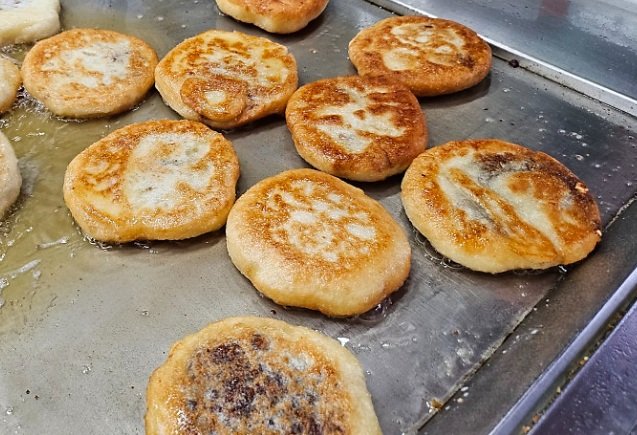
Imagine walking through a narrow Seoul alley on a freezing December evening. Your breath hangs in the air like little clouds, your fingers are numb, and the cold bites at your ears. Then you catch it — a wave of warm sweetness drifting from a tiny cart ahead. The sizzle of dough hitting hot oil, the golden glow under a bare lightbulb, and a long line of people huddled together, waiting for one thing: Hotteok(호떡).
This is how Korea welcomes winter. Not with a fancy dessert or an expensive café drink, but with a humble, hand-held pancake that costs barely a dollar and warms you from the inside out.
Ingredients & Calories
Hotteok is made from surprisingly simple ingredients — flour dough, warm water, yeast, sugar, cinnamon, crushed peanuts, and a touch of oil for that irresistible golden crisp. Some variations add sesame seeds or sunflower seeds for extra crunch.
Each piece contains roughly 200–300 kcal, making it a satisfying but not overly heavy winter snack. The outside is crispy and slightly chewy, while the inside melts into a warm, syrupy sweetness that feels like a hug on a cold day.
Origin & History
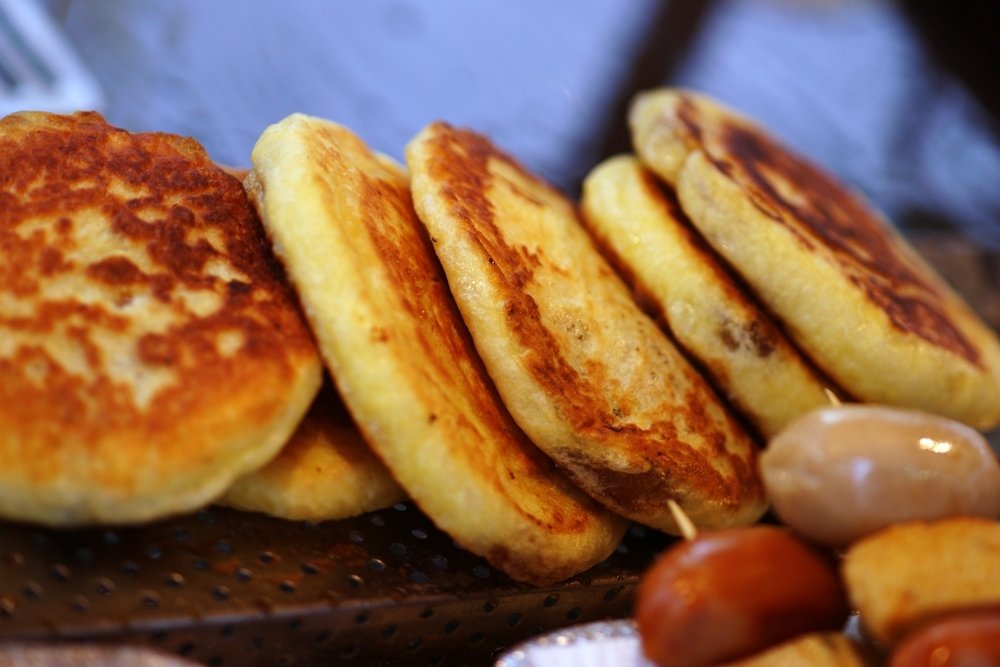
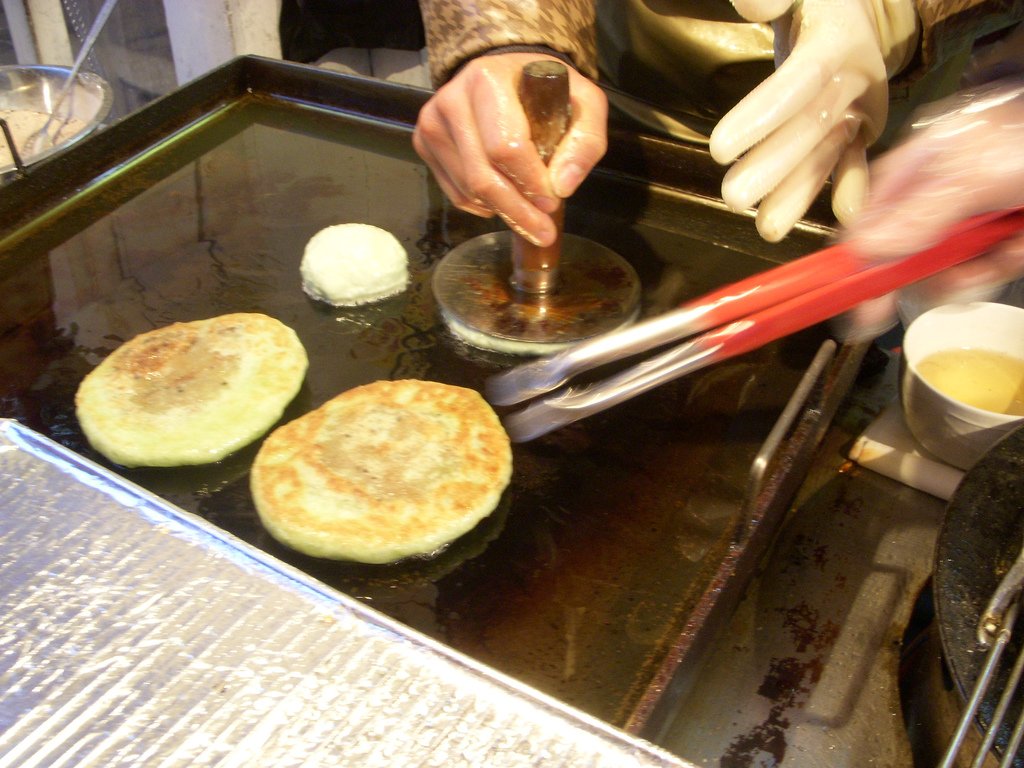
Hotteok’s story begins in the late 19th century, when Chinese immigrants brought a filled dough snack to the Korean peninsula. Koreans didn’t just adopt it — they transformed it into something entirely their own, replacing the original fillings with brown sugar and cinnamon, and pressing the dough flat on a greased griddle until it became golden and crispy.
As Korea’s vibrant street-market culture flourished throughout the 20th century, Hotteok rose to become one of the country’s most beloved winter staples. From small-town markets to the bustling streets of Myeongdong, it became the taste of Korean winter itself.
Types & Variations
While the classic brown-sugar Hotteok remains the king, decades of creativity have produced some wonderful variations:
Classic Sweet Hotteok
The original. Filled with brown sugar, cinnamon, and crushed peanuts. Simple, perfect.
Seed Hotteok (씨앗호떡)
Busan’s famous contribution. Packed with sunflower seeds, pumpkin seeds, and various nuts, offering a satisfying crunch with every bite.
Cheese Hotteok
A modern twist loved by younger generations. Stretchy mozzarella meets sweet dough in a combination that shouldn’t work but absolutely does.
Vegetable & Japchae Hotteok
Savory versions stuffed with glass noodles and vegetables. More of a meal than a snack.
Green Tea Hotteok
The dough is infused with matcha powder, adding an earthy bitterness that balances the sweet filling beautifully.
Honey Hotteok (꿀호떡)
Filled with honey syrup instead of sugar. Extra sticky, extra sweet, extra indulgent.
Where to Find Hotteok
Hotteok stalls appear wherever people gather — traditional markets, festival streets, subway station exits, and open plazas near shopping centers. You don’t need to search for them; on a cold winter evening, just follow your nose.
Some of the most famous spots include:
Busan’s BIFF Square
Home of the legendary seed Hotteok, where lines can stretch around the block.
Seoul’s Namdaemun Market
Classic sweet Hotteok in one of Korea’s oldest and largest traditional markets.
Gwangjang Market
A treasure trove of Korean street food where Hotteok sits alongside bindaetteok and tteokbokki.
A single Hotteok typically costs just 1,000–2,000 KRW (about $0.75–$1.50 USD), making it one of the most affordable pleasures in Korea.
Who Loves Hotteok? Everyone.
For children, it’s a sweet little treasure from the market, eaten with sticky fingers and wide eyes. For students, it’s a warm celebration shared with friends after school on a freezing afternoon. For office workers, it’s the comfort waiting at the subway exit on the long walk home. For travelers, it’s the first emotional taste of a real Korean winter.
Different reasons, different ages, same affection — Hotteok is a snack that transcends generations.
Hotteok vs. Western Pancakes & Crepes
If you’re trying to picture Hotteok, you might think of pancakes or crepes — but the experience is completely different.
Pancakes are soft, fluffy, and meant for a cozy breakfast at the table with syrup and butter. Hotteok is a hand-held street snack, crispy on the outside, with the sweetness sealed inside like a warm secret.
Crepes are thin, elegant, and refined — something you’d eat at a Parisian café. Hotteok is hearty, unpretentious, and comforting in the most nostalgic way — something you’d eat standing in the cold, shuffling from foot to foot, grinning because it just tastes that good.
They share the concept of dough + filling, but the emotional experience couldn’t be more different.
A Warm Memory in Every Bite
The moment you hold a freshly made Hotteok in your hands, you feel a gentle warmth seep into your cold fingers — and somehow into your heart as well. You bite through the crispy shell, and the sweet syrup flows out, rich with cinnamon and melted sugar. The cold winter air suddenly feels a little less harsh.
This is what makes Hotteok more than just street food. It’s a small memory filled with the emotion, scenery, and warmth of Korean winter. Whether you’re a local who’s been eating it since childhood or a traveler tasting it for the first time, Hotteok has a way of making you feel like you belong on that cold street corner, in that moment, with sweetness melting in your mouth and warmth spreading through your chest.
If you ever find yourself in Korea during winter, don’t just look for Hotteok — let it find you. Follow the steam, follow the sweet smell, follow the line of people smiling in the cold. That’s where the magic is.


